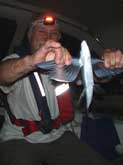
 |
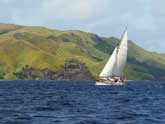
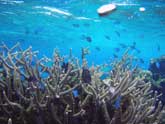
| Empire underway west of Mamanucas. |
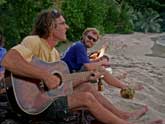 |
| Lovely days at Fiji, Ian and Nathaniel. |
 |
| Our "hostesses" on th eisland Ono, the faily O'Connor. |
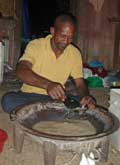 |
| Testing the kava before the ceremony. |
 |
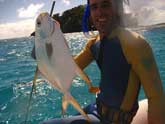 |
| Ian, s/y Afriki. |
 |

|
We got enough wind
on the voyage from New Zealand to Fiji. The first three days was as
expected well above average. Even though, with three reefs in the mainsail
and just a little piece of the genoa out, the comfort onboard Empire
was not too bad. Our three crew-members from the States got into it
after a while – when the wind finally calmed down…
Nathaniel, Sandra and Wally were originally crewing onboard the American
Yacht Bahati. Because of illness in the owner-family back in the USA,
Bahati didn’t leave Opua as planned, and we offered the guest-crew
a “lift” with Empire.
When we arrived
in Suva, the capital of Fiji on the island Vitu Levu, we measured 29°C
in the sea. That is 10 degrees warmer than when we left New Zealand
– it was lovely to be back in warm waters.
In Suva we couldn’t do anything but get into the Pacific rhythm
again – “if it doesn’t happen today, it happens another
day…” The authorities took their time before finally getting
started clearing us in to Fiji. The Empire-crew couldn’t do anything
but relax the long eight hours we waited for the authorities to get onboard.
After a few days in Suva, we set of for the Astrolabe Reef and the island
Ono, just south of Suva. Sverre Erik in the Norwegian Yacht Vagabond
Virgin visited Ono the previous season, and advised us to give Ono a
visit. So why not? Only a few sailboats find their way to the small
village Waisomo on the island Ono every year.
Etiquette is important in Fiji, and we were a bit excited when we drove
the dinghy ashore. Some children were playing on the beach of Waisomo
and we sighted some houses through the trees as we landed the dinghy.
In the shadow of a big tree some of the village-people were taking a brake.
According to old tradition you have to ask the Chief of the village
for permission to anchor, to fish, to take a bath or to go ashore on
the village property. The children on the beach took us to the Chief,
and Captain Eivind handed according to etiquette over the piece of kava
that we carefully had brought with us. Luckily the Chief accepted our
present. Then he told us that the village people would protect us –
if necessary - during our stay. The following evening the hole Empire-crew
was invited to Iso’s family’s house. Iso was the guy first
welcoming us to the village, so his family became our host-family during
our stay in Waisomo.
Kava is Fiji’s
national beverage. There was a “tanua” in the middle of
the floor in the living room. A tanua is a big Kava-bowl. The living
room itself was divided from the bedroom with a mosquito-net. Little
by little villagers gathered on the floor together with us and Iso’s
family. Kava was mixed and the drinking cup was filled and passed around.
How to serv and drink Kava is also ruled by etiquette. How the Kava
is dried, how the powder is mixed with water, who does the mixing, who
serves it and in what order it serves to whom is all important. For
the person drinking the Kava it is also important to follow the rules.
Everything that is in the cup, a half piece of a coconut shell, has
to be drunk in one gulp, and you have to say “thank you”
in a correct Fiji-way.
Kava gives a num feeling on the lips and on the thong. The Fijians can
get drunk on cava, but we did not feel anything but a little numbness.
None of us got very addicted to the light brown liquid. After four five
rounds of Kava most of Empire crew was very satisfied. During the evening,
which was one of more evenings to come with Kava-drinking, we learned
many things about the Fijians and their way of living.
The Fijians and the villagers of Waisomo in particular, are very hospitable.
One of the days on anchor outside Waisomo, we asked Iso to leave his
boat alongside Empire. Nathaniel and the Captain thought it was time
to give something back, and glassed together some of the damages in
the bearing construction of Iso’s boat. Something Iso was very
happy about.
The same evening as we got introduced to the secrets of Kava, Afriki
anchored in the same bay as Empire. Ian is the Captain onboard the Canadian
Yacht Afriki, and in the weeks to come we were going to know each other
well.
When we were happy
with the “city”-life in Waisomo, both yachts headed for
the main lagoon of the Astrolabe Reef. The following days Ian and Eivind
spent most of the days in the water. Ian is a capable skin-diver and
very clever with his spear-gun. Eivind was not that experienced, and
had a lot to learn from Ian. The boys stayed in the water from early
morning to late evening. The result was many good fish-meals, either
onboard Afriki or Empire or onshore around the fire on the beach.
One week later we finally hoisted our anchors, left Astrolabe Reef and
headed for the Mamanuca- and Yasawa islands, on the western side of
Vitu Levu. This is where most of the tourists not arriving by own boat
travels. Hostels and hotels are in all classes, from “backpacker”
and up to 2000 US a night. Luckily sailors are like the turtles –
we have our house with us…
We didn’t have particularly good charts for the area, but experienced
Yasawa-sailors gave us several tips and hint for good anchorages. Together
with our friends Ian and Shawna onboard Afriki, we had great days around
the Yasawa-islands. The days contained skin-diving, spear-fishing, kayaking,
expeditions with the Zodiac looking for Manta Ray or turtles, and cooking
of all the delicatessens of the sea
Our American crew
had been sailing with us for five weeks, and for two of them time were
about to run out. They had to head back home. Before this voyage with
Empire their only experience was costal sailing around Maine and they
had never done any sailing at night. Sandra and Wally discovered that
long voyaging was something totally different from sailing in protected
coastal waters.
Nathaniel, our third American crewmember, was going to sail with us
to Vanuatu, where we also hoped to meet our friend Josh, the son of
the owners of Bahati.
In Fiji we also met our Danish friends onboard Njord again. We met Njord
with Hanne and Bo first time in Portugal in 2005. Bo had some troubles
with the engine onboard Njord, so Bo and Eivind stuck their heads together
– two heads think more (and hopefully better) than one –
to find the problem and a solution to it. The problem had bothered them
since they got their overhauled engine back onboard in New Zealand.
The trouble was found – the mechanic in New Zealand had not tightened
the oil drain screw inside the flywheel-housing during his maintenance-work.
Meanwhile Hanne and Heidi enjoyed the opportunity to find out more about
the city of Lautoka.
When the people
in Fiji say “Bula”, it means “hello”. Almost
half the population have their roots back to India. We found the India-related
people to be a bit shyer than the Fijians. The people in Fiji are in
general very friendly and are in no rush. They enjoyed to tell about
their local traditions to curious Norwegians. If you manage to learn
a few words of Fijian language you will always be welcomed. By the way
“Vinaka vaka levu” means “thank you very much”.